Saturday, March 27, 2010

Amanojaku concert


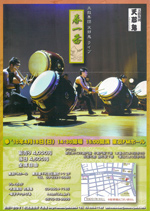
Amanojaku at Tokyo FM Hall
"HARU ICHIBAN (Spring Breeze)"

SUN April 18, 2010
3 p.m. (doors open 2:30 p.m.)

Taiko drumming by
Amanojaku leader/composer Yoichi Watanabe
with drummers
Hiromi Ogawa, Isaku Kageyama, Daisuke Watanabe, Hiromi Sekine, Chris Holland,
and guests
Kyosuke Suzuki on fue flutes, Katsunari Sawada on Tsugari shamisen
also
Amanojaku Hozonkai.

1-7 Kojimachi Chiyoda-ku Tokyo
TEL: 03-3221-0080
3 minute walk from exits 1 and 2 Hanzomon station on the Hanzomon Line.
6 minute walk from exits 1 and 2 Kojimachi station on the Yurakucho Line.

Advance tickets 4,000 yen
Same-day admission 4,500 yen

For tickets, please call Amaonojaku TEL: 03-3904-1745
Ticket Pia (from March 30, 2010)
Pコード:103-507 TEL:0570-02-9999
No reserved seating.

The Sociology of Hanami (flower-watching)

Every year about this time of the year Japanese _ it seems every Japanese brings out big blue sheets of plastic to sit beneath cherry trees.
The practice of planting cheery trees in rows dates back to the Edo Period, where "hanami," or flower-watching, started and is depicted in ukiyoe scrolls.
The springtime party was a big equalizer for a culture dominated by the bustling "iki" merchant class _ so different from the stuck-up somber divisive nobility of the previous eras.
Beneath the trees exploding with blossoms, people sit flat on the ground as equals, eating, singing, talking in big voices, drinking, reveling in their equality, practicality and vulgarity.
The branches are foaming with pale pink blossoms, some petals wafting with their sweet scent likes pieces of chiffon.
In contrast, the food smells bad, poorly made sushi, fried chicken and noodles.
Canned beer is guzzled, and the talking is loud.
Only in a strictly hierarchical society would the symbolic equalizer of hanami be so highly valued.
Japanese thrive on the democratic myth of hanami.
Although the purpose of these gatherings is to look at flowers, no one bothers to ask if anyone is really looking.
It is unclear whether people are just pretending to have a good time or they are really having a good time.
Everyone knows there is no such thing as equality in Japan _ a nation where the dumbest man is superior to the most qualified woman, and status is won by seniority and inheritance and personal ties _ not performance or productivity _ and language and mannerisms are defined by where one stands in strictly defined rankings.
In fact, the lowliest one, like a woman or the newly hired recruit at a company, has to go early and mark out the hanami spot beneath a tree with the blue plastic to make sure no other group takes that spot.
Some equality.
The picnic continues into the night.
Too drunk, some people are barely able to stand.
Lovers of group behavior to the max, Japanese come out in hordes during hanami season, the two weeks or so when the cherry trees are in bloom.
No matter that the crowds sitting, in some parks, right next to each other like a commuter train, are nothing but a blight to the scenic landscape.
If you question hanami, if you are not having the ball of your life, you are not a true Japanese.
Tuesday, March 2, 2010

who is the poet? a poem by Yuri Kageyama

who is the poet?
a poem by Yuri Kageyama

poets who pause to pontificate
poets who write for grants
poets who count syllables
poets who admire texture of words
i work and have no time
and i have no time for
poets who have all the time
poets who find poetic moments
poets who teach laureate poetry
poets who chatter on Facebook
it is blood in the veins
to kill and give birth and die
i am the true poet, not you
poets of the revolution
poets weeping tears at bars
poets who don't write lyrics
poets of pure soundless music
angels of suicide
bridge of neon, cliff of ice
we are the true poets, not you

message to marry

Hi Marry
You left a very nice comment on my previous post, but I deleted it by mistake.
Thanks for being so supportive of my writing.
It would have been great to add your words to this whole effort.
Lots of love,
Yuri

Saturday, February 27, 2010

Terumasa Hino


Terumasa Hino with Toshiko Akiyoshi at Lake Biwa in 1986.

Sometimes there are moments in life that make an artist feel it was all worth it.
It helps when an older and more experienced artist is willing to give of him/herself and encourage a younger and less experienced artist _ giving assurance there is nothing to be afraid of, that all you have to do is be yourself.
Isaku felt just that last night _ with trumpet legend Terumasa Hino, of all people.
At a benefit for Haiti earthquake survivors, Hino casually picked up his trumpet, started playing his horn impromptu, its ring like a greeting, surprising Isaku from behind, but joining him in music, playfully chatting with Isaku's drumming, telling him there is nothing to be afraid of, that all you have to do is be yourself.
Unlike some aspects of life, dictated by shallow rules of winning vs. losing, where petty minds pursue a zero-sum game, and the whole and the sum of its parts only negate each other into shameless nothingness, music is the pure joy of life, where the sound that is wholeness is far more beautiful than the sum of its parts.
For just a few fun moments, jazz and taiko met.

Terumasa Hino at the Budokan in Tokyo 1992.

Sunday, January 24, 2010

At One With Brazil

Amanojaku's Yoichi Watanabe and Isaku Kageyama are now in Brazil to share the joy of taiko.
"Kizuna" was co-written by Watanabe and the late Daihachi Oguchi of Osuwa Daiko for the 100th anniversary of Japanese immigration to Brazil, celebrated June 21,
2008 by a performance of 1,000 Brazilian taiko drummers.
The first four minutes of the piece is trademark Oguchi, and then the song breaks into Amanojaku-style taiko that is totally and distinctly Watanabe.
Below is video of a group in Brazil performing "Kizuna" in December:

And this is the same song performed by Amanojaku and students in Japan:

Amanojaku traveled to Brazil 6 times during 2004-2008, teaching more than 600 Japanese-Brazilian youngsters.
The performance was attended by 37,000 people, including Crown Prince Naruhito.
"Kizuna" means "bond" in Japanese _ what is in our heritage and our blood that transcends boundaries and the passage of time to connect people in spirit.
Amanojaku has continued to go to Brazil to teach in 2009 _ and now in 2010.

Saturday, January 16, 2010

Amanojaku at Sogetsu Hall


Amanojaku concert at Sogetsu Hall in Tokyo Dec. 8, 2009.
"Kaiun" by Yoichi Watanabe, performed by (from left to right) Daisuke Watanabe, Isaku Kageyama, Yoichi Watanabe and Hiromi Ogawa.