Showing posts with label Tokyo. Show all posts
Showing posts with label Tokyo. Show all posts
Friday, February 11, 2011
Fun music in Tokyo
Taiko drummer Isaku Kageyama shows he can swing on traps drums as well, delivering the pulse for Keisuke Kato, the guitarist singing his composition for a Valentine's LOVE get-together at St. Blue in Asakusa, Tokyo, THU Feb. 10, 2011.
Some buzzing in the first part of the Ustream video but OK otherwise for an iPhone effort.
Below, the encore they said they wouldn't do _ so it's impromptu, blog readers and Ben E. King.
Thanks for the music, guys.
Everybody had a great time.


Sunday, January 23, 2011
Music in Tokyo (again)
Tokyo rocks when Carl Freire picks up his guitar and gets up on stage.
And what a steady hand I have as videographer with my iPhone.
Please admire Carl _ and my steady hand.
Thursday, December 16, 2010
mix of taiko beats out the new in familiar sounds
Click on this, "Midare Uchi" to watch on YouTube in a rare collaboration by drummers from three Tokyo groups plus a kawaii guest.
from the recent BEAT AHEAD at Roppongi's SuperDeluxe in Tokyo starring Isaku Kageyama of Amanojaku, Yuu Ishizuka of Bachiatari and Makoto Sekine of Medetai.
Below, they join forces on "Bujin" the trademark Amanojaku piece by master composer Yoichi Watanabe.
Click on this to see that _ also on YT as the embedding isn't working for some reason.
from the recent BEAT AHEAD at Roppongi's SuperDeluxe in Tokyo starring Isaku Kageyama of Amanojaku, Yuu Ishizuka of Bachiatari and Makoto Sekine of Medetai.
Below, they join forces on "Bujin" the trademark Amanojaku piece by master composer Yoichi Watanabe.
Click on this to see that _ also on YT as the embedding isn't working for some reason.
Friday, December 10, 2010
Music in Tokyo
Heard the other day at Gamuso, a cool artsy dive in Tokyo where I have read poetry with music a couple of times, Samm Bennett on the diddley bow, a one-string instrument made of a marron glace box, speaking a million words with a single string, his voice and his heart.
Saturday, November 13, 2010
Taiko as REAL MUSIC in Tokyo
Not your everyday around-the-corner taiko, this is serious music that challenges the boundaries of ethnic tradition and identity and universal eternal art.
Isaku Kageyama with Daisuke Watanabe and Chris Holland of Amanojaku Tokyo's top taiko group led by master drummer and composer Yoichi Watanabe play in a collaborative concert with Yuu Ishizuka, and Makoto Sekine.
SUN Nov. 28 6 p.m.
at Roppongi SuperDeluxe
3-1-25-B1 Nishi Azabu Minato-ku Tokyo, Japan.
TEL: 03-5412-0515
3,500 yen w/advance reservation.
4,000 yen at the door.
Monday, August 23, 2010
Mother Earth Orchestra at Harajuku Crocodile Aug. 19, 2010
"Improvisation"
Kazutoki Umezu (sax)
NATA (digeridoo)
Craig Harris (bass)
Winchester Nii Tete (percussion)
Isaku Kageyama (taiko and percussion)
Kazutoki Umezu (sax)
NATA (digeridoo)
Craig Harris (bass)
Winchester Nii Tete (percussion)
Isaku Kageyama (taiko and percussion)
Thursday, August 19, 2010
clips of music tonight

Video from my iPhone at links below just to give you an idea of what happened.
http://www.ustream.tv/recorded/9017533
better quality video upcoming soon on YouTube:
http://www.ustream.tv/recorded/9018480
at Harajuku Crocodile in Tokyo Thursday evening Aug. 19, 2010.
http://www.ustream.tv/recorded/9018530
the Music will get better.
music tonight


please come to the Crocodile in Omotesando tonight (see previous blog post for details).
follow Isaku Kageyama on Twitter _ @isakukageyama
and claim your free beer tonight:
木曜日に原宿クロコダイルでライブやります。 僕に「ツイッターで見た」と話しかけてくれればクロコダイルビールご馳走します。 http://j.mp/cCTDlM
Playing at Harajuku Crocodile from 20:00 on Thursday the 19th. I'll buy you a beer if you make it out!
Isaku will be cooking up a melting plot of a hot groove with Japanese sax legend Kazutoki Umezu, master percussionist from Ghana Winchester Nii Tete, bassist virtuoso from the US Craig Harris and a Japanese who plays an aboriginal instrument NATA.
No borders for this batch.
Saturday, August 7, 2010
electronic taico by Isaku Kageyama in Tokyo
Taiko drummer Isaku Kageyama will be among those playing at Summer Sounds at Laputa in Aoyama _ a restaurant, swimming pool and music club all in one in Tokyo _ next Saturday, Aug. 14 at about 8 p.m.
The event starts at noon and continues until 11 p.m. Admission is free if you get there by 2 p.m. (if you're into that).
The flyer giving samples of artists' performances here.
Isaku's take on the endeavor in his blog entry here.
So eat, swim, dance, groove, sit aorund, whatever but listen to good music.
Saturday, July 24, 2010
Amanojaku at Super Deluxe in Tokyo in May 2010
the younger members of Amanojaku a taiko group in Tokyo
from left to right:
Chris Holland, Isaku Kageyama, Daisuke Watanabe, Hiromi Sekine.
Sunday, November 1, 2009
The Autobiography of Yoichi Watanabe
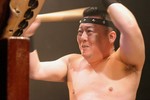
Yoichi Watanabe, (photo by Naokazu Oinuma) leader of Tokyo taiko group Amanojaku, is relating his life history and his thoughts on taiko to Isao Tokuhashi and me.
It is a project that has just begun. And a lot of work still awaits.
But it fascinates me for what it promises to deliver in understanding of a great artist, an important era of post-war Japanese creativity and the conceptual and spiritual backbone of modern music called taiko.
Yoichi Watanabe founded Amanojaku in 1987.
But his story _ one man's journey in taiko _ began in the late 1960s, when he was about 10 years old.
He lived through the pioneering years of Tokyo-style taiko, playing with Sukeroku Daiko, founded in 1959 as this city's first professional kumi-daiko troupe.
An excerpt from "The Autobiography of Yoichi Watanabe _ as told to Isao Tokuhashi and Yuri Kageyama":
To be honest, I am not sure anyone would want to read a book about my life.
Besides, 10 years from now, my thoughts are bound to have changed, and I would need to write another book.
But I’ve always wanted to write down a certain philosophy on life that I have arrived at over the years in my own small way.
There is such a thing in life as the correct path _ a “seido.”
I am no different in having pursued what I thought was this correct path for me.
I have been doing it all my life.
I was in fourth grade when I decided I wanted to be a taiko drummer.
And I have never swerved from that path.
And it was just one path.
It was not an easy path, one filled with thorny bushes along the way.
But I have developed a way of looking at life through taiko.
And so this book is not a manual about how to play taiko.
Please look at a DVD or a read a manual textbook for that.
Everyone starts out with a dream, and then many people arrive at another way of life to make a living.
You may want to be a doctor or a pilot. But if you can’t realize that dream, you may have to settle on a more realistic job.
We are supposedly in the worst crisis in a century.
People are all working hard.
Perhaps they would be encouraged to find I have never gone far astray from my path over all these years.
I don’t have anything all that special to say.
It’s very ordinary. It’s no different from everyone else’s dreams.
If you keep yourself open, then you will realize your goal in all its depth and breadth.
That kind of spirit has been lost, this spirit I have strived to pursue all my life.
It’s human to seek the easy way, but I have stuck to the way even if it meant hardships.
If people tell me to go one way, then sometimes I question that and go counter-clockwise.
I have always been a rebel, an Amanojaku.
Sunday, October 11, 2009
Music at the Moon Stomp

From left to right: Isaku Kageyama, Winchester Nii Tete, Robby.
The "MoveThatPoem" poets from Spain read after the music at the Moon Stomp in Koenji Tokyo Sunday Oct. 11, 2009.
The music keeps getting stronger.
And the poetry _ read in their Spanish original by the poets, followed by English translations _ was a perfect way to end a multicultural evening.
Isaku plays with minyo musicians tomorrow night Monday, Oct. 12, 2009, at Takanoya in Shinjuku, Tokyo.
Saturday, September 19, 2009
Book party for Frank Spignese

There is a book party for Frank Spignese tomorrow night.
I wasn't going to miss it for the world anyway, but Frank has invited me to read. Thank you, Frank.
And congratulations on your book!!!
Friday, August 14, 2009
Literature, music and dance Aug. 23 at GAMUSO

A message from organizer David Hoenigman:
Please don't forget PAINT YOUR TEETH vol. 4
Sunday, Aug. 23rd.
Gamuso in Asagaya.
6:30 door opens
A NIGHT OF PUSHING THE ENVELOPE OF LITERATURE, MUSIC AND DANCE
opens with IN MINOTAUR!!! going on at 6:45PM.
still only 1,000 yen ! (including 1 drink so really only 500 yen)
DEFEKTRETTS no boys allowed incarnation of junk machine sound pioneers DEFEKTRO: one dj and two noise makers.
David F. Hoenigman reads from his antinovel in progress "Squeal For Joy"
with a slide show featuring artwork by Yasutoshi Yoshida.
Yuri Kageyama has collaborated with musicians, dancers and visual artists in performances of her poetry. She has read with Ishmael Reed and Shuntaro Tanikawa among many others.
Kei Kunihiro death metal crooner and Internet sensation. 435,540 views and counting!
LIVING ASTRO the Joe Meek adoring rock/sample/synth mutant pop duo.
SHIT _ slapdash assembly of area experimental musicians on a burning ferris wheel: OWKMJ, Taishin Inoue, Ezra Woolnough and many others.
see you there!
David
Monday, June 23, 2008
Story of Miu 10
Story of Miu 9
List of links to previous Miu entries
Story of Miu 10
The Moon Stomp in Koenji is smaller than most American kitchens, and it really does have a kitchen, where sweet-smelling pizza and hot spicy curry are getting cooked up, but what's really cooking is the music.
Miu wanted me to come and hear her play with Yuga's band.
I'm trying not to expect too much, but I need not have worried.
Descend from the streets into that tiny smoke-filled club, packed with kids in hats and T-shirts, and the music there is so feel-good, giggles-provoking and harmonious Japanese-style it's like soaking in sudsy lukewarm tub water.
Admission is 2,500 yen for an all-you-can-eat meal-included evening of music.
Merrychan is a trio that performs original Japanese-language versions of Cuban and other Latin music.
Hearing Japanese sung and yelled in Latin fashion is somehow funnier than you'd think. Speak about identity crisis and parodying Japan's imitative modern music scene!
See how "Gerohaita! (He barfed!)" almost sounds Spanish? It's that wit in not taking oneself too seriously that makes these musicians rise above their otherwise proficient but pretty hunkydory (I mean, how could a bunch of Japanese kids beat Los Van Van?) musicianship to something unique, and something definitely entertaining.
No wonder the crowd (of about 30, half of them members of the other performing bands) is ecstatic.
Funyakotsu-ting was a geeky looking pudgy guy with glasses and a T-shirt with a picture of a donkey that said in English: "Bad Ass." He sang, narrated tales and even performed karaoke with a guitar.
A far cry from a demonstration of musical technique or artistic message, the almost-freak-show "otaku" performance still exudes a strange utterly disarming charm.
Several fans sat in the front row with multicolored light-sticks and swayed them in time to the music on one tune like they were at a Budokan rock concert.
Most straight-ahead but just as hippie-spiritied was Cigarette She Was, a folk/pop band led by guitar-strumming singer Teruyuki Kawabata. The groups were selling their CDs for something like 200 yen, the equivalent of $1.50.
Yuga plays kpanlogo in this band, his deep eyes _ those that Miu says look like those of an elephant _ buried in his long black hair as he plays with quiet concentration. He is sometimes so serious his upper lip seems to curl up in a haughty snarl.
Miu is so happy she can barely sit still as she jumps around, shaking a wooden stick covered with jangling bells.
I sit in one of the front seats surrounded by the cuddly noises and the warm smell of food and forget all thoughts.
It's a numbing feeling of thoughtless and humble satisfaction.
Who would have imagined that just a couple of months later Miu would break up with Yuga?
They are so young maybe it was to be expected.
She says it started with a quarrel about how to play a musical phrase in a rehearsal in their tiny apartment.
But when she shouted back, he slapped her then pushed her down on the tatami mat.
"I almost hit my head on the corner of his desk," Miu tells me, horrified.
She has to move out immediately, and so I have to go pick her up in our car.
Perhaps hoping to stop her from leaving, Yuga told her that he couldn't end the painful cycle of violence: He was beaten as a child while he was growing up.
His parent were very strict with him because he was an only child and they had such great hopes for him.
He was the kind of kid who couldn't even ask for a toy.
The parents would spank him and beat him and kick him and push him out, even in the winter, naked out into the backyard, although he screamed and stamped his little feet and cried as though his little lungs will tear into pieces.
But sometimes, when he feels that rage burn inside him, he is still that kid, and he can't stop himself when he wants it set things right and he must hit that person in front of him whom he loves so dearly yet who is acting in a way that he despises.
"It's totally messed up," Miu says. "He says he can't forgive his father, but I am not going to forgive him."
It is a sad end to a totally peaceful, hippie story of young love and brainlessly joyous music.
Or so I thought _ except that wasn't the end at all.
List of links to previous Miu entries
Story of Miu 10
The Moon Stomp in Koenji is smaller than most American kitchens, and it really does have a kitchen, where sweet-smelling pizza and hot spicy curry are getting cooked up, but what's really cooking is the music.
Miu wanted me to come and hear her play with Yuga's band.
I'm trying not to expect too much, but I need not have worried.
Descend from the streets into that tiny smoke-filled club, packed with kids in hats and T-shirts, and the music there is so feel-good, giggles-provoking and harmonious Japanese-style it's like soaking in sudsy lukewarm tub water.
Admission is 2,500 yen for an all-you-can-eat meal-included evening of music.
Merrychan is a trio that performs original Japanese-language versions of Cuban and other Latin music.
Hearing Japanese sung and yelled in Latin fashion is somehow funnier than you'd think. Speak about identity crisis and parodying Japan's imitative modern music scene!
See how "Gerohaita! (He barfed!)" almost sounds Spanish? It's that wit in not taking oneself too seriously that makes these musicians rise above their otherwise proficient but pretty hunkydory (I mean, how could a bunch of Japanese kids beat Los Van Van?) musicianship to something unique, and something definitely entertaining.
No wonder the crowd (of about 30, half of them members of the other performing bands) is ecstatic.
Funyakotsu-ting was a geeky looking pudgy guy with glasses and a T-shirt with a picture of a donkey that said in English: "Bad Ass." He sang, narrated tales and even performed karaoke with a guitar.
A far cry from a demonstration of musical technique or artistic message, the almost-freak-show "otaku" performance still exudes a strange utterly disarming charm.
Several fans sat in the front row with multicolored light-sticks and swayed them in time to the music on one tune like they were at a Budokan rock concert.
Most straight-ahead but just as hippie-spiritied was Cigarette She Was, a folk/pop band led by guitar-strumming singer Teruyuki Kawabata. The groups were selling their CDs for something like 200 yen, the equivalent of $1.50.
Yuga plays kpanlogo in this band, his deep eyes _ those that Miu says look like those of an elephant _ buried in his long black hair as he plays with quiet concentration. He is sometimes so serious his upper lip seems to curl up in a haughty snarl.
Miu is so happy she can barely sit still as she jumps around, shaking a wooden stick covered with jangling bells.
I sit in one of the front seats surrounded by the cuddly noises and the warm smell of food and forget all thoughts.
It's a numbing feeling of thoughtless and humble satisfaction.
Who would have imagined that just a couple of months later Miu would break up with Yuga?
They are so young maybe it was to be expected.
She says it started with a quarrel about how to play a musical phrase in a rehearsal in their tiny apartment.
But when she shouted back, he slapped her then pushed her down on the tatami mat.
"I almost hit my head on the corner of his desk," Miu tells me, horrified.
She has to move out immediately, and so I have to go pick her up in our car.
Perhaps hoping to stop her from leaving, Yuga told her that he couldn't end the painful cycle of violence: He was beaten as a child while he was growing up.
His parent were very strict with him because he was an only child and they had such great hopes for him.
He was the kind of kid who couldn't even ask for a toy.
The parents would spank him and beat him and kick him and push him out, even in the winter, naked out into the backyard, although he screamed and stamped his little feet and cried as though his little lungs will tear into pieces.
But sometimes, when he feels that rage burn inside him, he is still that kid, and he can't stop himself when he wants it set things right and he must hit that person in front of him whom he loves so dearly yet who is acting in a way that he despises.
"It's totally messed up," Miu says. "He says he can't forgive his father, but I am not going to forgive him."
It is a sad end to a totally peaceful, hippie story of young love and brainlessly joyous music.
Or so I thought _ except that wasn't the end at all.
Saturday, May 31, 2008
For women only
For women only
perfume,
rubbing shoulders,
we rattle silently over the tracks
blouses, tucked bags, even powdered chins,
up too close to really see;
we sense only relief
we smell no greasy beards or sweaty suits or
beer breath of the morning after _
this morning commuter train
"josei senyo sha"
reserved
for women only,
introduced to protect the gentle sex
from those groping dark hands
preying prying fingers, stroking thigh,
poking panties,
pretending to be penises
right in public transport,
"josei senyo sha"
this is the kindness of Japanese society:
let chikan go unchecked,
forgiven for their mischief,
and give us, women, this special spot
farthest from the action
farthest from the ticket gates
the first car up front,
and the most dangerous
if we crash
perfume,
rubbing shoulders,
we rattle silently over the tracks
blouses, tucked bags, even powdered chins,
up too close to really see;
we sense only relief
we smell no greasy beards or sweaty suits or
beer breath of the morning after _
this morning commuter train
"josei senyo sha"
reserved
for women only,
introduced to protect the gentle sex
from those groping dark hands
preying prying fingers, stroking thigh,
poking panties,
pretending to be penises
right in public transport,
"josei senyo sha"
this is the kindness of Japanese society:
let chikan go unchecked,
forgiven for their mischief,
and give us, women, this special spot
farthest from the action
farthest from the ticket gates
the first car up front,
and the most dangerous
if we crash
Sunday, December 30, 2007


Violinist Yumi Miyagishima (Shima)

This is a bit of a late entry but I spent Christmas at a small pub in Mitaka, where Shima played violin with a singer, pianist, bassist, guitarist and percussionist.
Tokyo is a haven/heaven for young musicians.
Instead of parties, people get together to listen to music for their souls' "iyashi." (The repertoire that night was a collage of sing/clap-alongs _ "Jingle Bells," "Sunny," Japanese pop, etc.)
Shima has always said she wants to play music.
Knowing What you Want is important in Life.
And never giving up/never compromising: It's easier said than done.
Although we may never achieve the heights of our craft we see as Ideal, we can keep going, day by day, (staying True to What We have Decided is our Life) and we go listen to Music in Mitaka to gain courage/strength/purity to go on for the next day.
Tuesday, November 6, 2007
Despair/Disco (Story of Miu 6)
Miu and I went to a DISCO called The Room in Shibuya.
And it was as tiny and shabby as a room.
People stood next to each other in rows and shifted their weight from one leg to the other nervously to the thump-thump of music as a mirror ball glistened sadly from a corner.
Miu says this is the new, tucked-away look of Tokyo discos.
The big slick ones with shiny floors are obsolete, although they apparently still exist in parts of Roppongi, where old men, many of them foreigners, try to pick up young Japanese women.
We were not dressed appropriately in our T-shirts and jeans.
You must wear short skirts and tops with your breasts about to fall out, then people will want to talk to you and want to have sex with you, according to Miu.
A DISCO is a place where boys take girls they pick up on the streets:
(1) By dancing, the male can make sexual overtures to the female and find out her interests/lack thereof in having sex.
(2) By dancing, the female will get tired, allowing the male to suggest going to a hotel to have sex.
A disco delivers relatively high return for low investment.
Dating for weeks to just kiss isn't efficient.
"There has to be someone out in the world who is your true love," Miu says, shouting a bit over the music.
"Romantic love must exist. Like Romeo and Juliet. Or is that unreal like a father's ghost or a forest moving, which aren't at all everyday like a disco?"
Miu says a man she got to know recently says he finds someone like Juliet a bit too much.
I'll tell her maybe it's better to hang out with another Capulet, or how about my friend Mercutio?
I may be someday someone's Romeo but I will never find a Juliet, he told Miu.
DESPAIR was one of the paintings on display in Uneo by Edvard Munch.
Munch's strongest works depict personal angst.
Despair, Anxiety and Scream were shown in two different sequences.
One had the Scream in the middle.
But the Scream has to be the culmination of the series.
Indeed, Munch painted them in that order: Despair, Anxiety, Scream.
Munch believed art should be about everyday people.
Never mind the people in the paintings may look psychotic, surreal and warped.
Not really everyday at all.
"I will paint living people who breathe and feel and suffer and love," Munch said.
And it was as tiny and shabby as a room.
People stood next to each other in rows and shifted their weight from one leg to the other nervously to the thump-thump of music as a mirror ball glistened sadly from a corner.
Miu says this is the new, tucked-away look of Tokyo discos.
The big slick ones with shiny floors are obsolete, although they apparently still exist in parts of Roppongi, where old men, many of them foreigners, try to pick up young Japanese women.
We were not dressed appropriately in our T-shirts and jeans.
You must wear short skirts and tops with your breasts about to fall out, then people will want to talk to you and want to have sex with you, according to Miu.
A DISCO is a place where boys take girls they pick up on the streets:
(1) By dancing, the male can make sexual overtures to the female and find out her interests/lack thereof in having sex.
(2) By dancing, the female will get tired, allowing the male to suggest going to a hotel to have sex.
A disco delivers relatively high return for low investment.
Dating for weeks to just kiss isn't efficient.
"There has to be someone out in the world who is your true love," Miu says, shouting a bit over the music.
"Romantic love must exist. Like Romeo and Juliet. Or is that unreal like a father's ghost or a forest moving, which aren't at all everyday like a disco?"
Miu says a man she got to know recently says he finds someone like Juliet a bit too much.
I'll tell her maybe it's better to hang out with another Capulet, or how about my friend Mercutio?
I may be someday someone's Romeo but I will never find a Juliet, he told Miu.
DESPAIR was one of the paintings on display in Uneo by Edvard Munch.
Munch's strongest works depict personal angst.
Despair, Anxiety and Scream were shown in two different sequences.
One had the Scream in the middle.
But the Scream has to be the culmination of the series.
Indeed, Munch painted them in that order: Despair, Anxiety, Scream.
Munch believed art should be about everyday people.
Never mind the people in the paintings may look psychotic, surreal and warped.
Not really everyday at all.
"I will paint living people who breathe and feel and suffer and love," Munch said.
Subscribe to:
Posts (Atom)
