Thursday, April 8, 2010
Tadanori Yokoo on Twitter
The way Tadanori Yokoo uses Twitter gives the technology a new dimension. He tweets the way he draws. It's an approach to life/death and meaning/meaninglessneess and the gaps/spaces in-between. He throws his words out as they cross his mind, reaching out to the other reality that is the shadow of death and the faraway universe inhabited by aliens calling out to us in beeps and brush strokes and gasps of a deranged poet. They come and go, lost into cyberspace, our blood, our flashes, our yearnings, our art. They are maybe ignored, cast away, or found and even treasured before being forgotten like grandmothers and mothers and aborted daughters, and they cross like sparkling crystal of stars through the black universe, hurling into consciousness and lives and thoughts and desperate clawing at art by lonely artists and careless carefree tweets.


Tuesday, April 6, 2010
wise words
DO YR ART D WAY U WANT
ANYWAY U WANT
ANY WANGOL U WANT
ITS UP TO U/WHAT WILL WORK
FOR U.
_ from "Catechism of d Neoamerican Hoodoo Church," a poem by Ishmael Reed.
ANYWAY U WANT
ANY WANGOL U WANT
ITS UP TO U/WHAT WILL WORK
FOR U.
_ from "Catechism of d Neoamerican Hoodoo Church," a poem by Ishmael Reed.
Saturday, April 3, 2010
taiko vs hip-hop
what does it mean to be Japanese? what does it mean to be American? what is yellow vs. what is black/white? what is Music? what is art? and what does it mean to be human? no easy answers ever but key questions in life and what being an artist is all about.
Taiko with bon odori tune "Hokkai Bon Uta"
Taiko with "Waterfalls" by TLC
Taiko with Snoop Doggy Dogg's "Ain't No Fun"
Taiko with bon odori tune "Hokkai Bon Uta"
Taiko with "Waterfalls" by TLC
Taiko with Snoop Doggy Dogg's "Ain't No Fun"
Saturday, March 27, 2010
Amanojaku concert
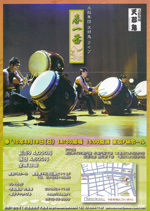
Amanojaku at Tokyo FM Hall
"HARU ICHIBAN (Spring Breeze)"
SUN April 18, 2010
3 p.m. (doors open 2:30 p.m.)
Taiko drumming by
Amanojaku leader/composer Yoichi Watanabe
with drummers
Hiromi Ogawa, Isaku Kageyama, Daisuke Watanabe, Hiromi Sekine, Chris Holland,
and guests
Kyosuke Suzuki on fue flutes, Katsunari Sawada on Tsugari shamisen
also
Amanojaku Hozonkai.
1-7 Kojimachi Chiyoda-ku Tokyo
TEL: 03-3221-0080
3 minute walk from exits 1 and 2 Hanzomon station on the Hanzomon Line.
6 minute walk from exits 1 and 2 Kojimachi station on the Yurakucho Line.
Advance tickets 4,000 yen
Same-day admission 4,500 yen
For tickets, please call Amaonojaku TEL: 03-3904-1745
Ticket Pia (from March 30, 2010)
Pコード:103-507 TEL:0570-02-9999
No reserved seating.
The Sociology of Hanami (flower-watching)
Every year about this time of the year Japanese _ it seems every Japanese brings out big blue sheets of plastic to sit beneath cherry trees.
The practice of planting cheery trees in rows dates back to the Edo Period, where "hanami," or flower-watching, started and is depicted in ukiyoe scrolls.
The springtime party was a big equalizer for a culture dominated by the bustling "iki" merchant class _ so different from the stuck-up somber divisive nobility of the previous eras.
Beneath the trees exploding with blossoms, people sit flat on the ground as equals, eating, singing, talking in big voices, drinking, reveling in their equality, practicality and vulgarity.
The branches are foaming with pale pink blossoms, some petals wafting with their sweet scent likes pieces of chiffon.
In contrast, the food smells bad, poorly made sushi, fried chicken and noodles.
Canned beer is guzzled, and the talking is loud.
Only in a strictly hierarchical society would the symbolic equalizer of hanami be so highly valued.
Japanese thrive on the democratic myth of hanami.
Although the purpose of these gatherings is to look at flowers, no one bothers to ask if anyone is really looking.
It is unclear whether people are just pretending to have a good time or they are really having a good time.
Everyone knows there is no such thing as equality in Japan _ a nation where the dumbest man is superior to the most qualified woman, and status is won by seniority and inheritance and personal ties _ not performance or productivity _ and language and mannerisms are defined by where one stands in strictly defined rankings.
In fact, the lowliest one, like a woman or the newly hired recruit at a company, has to go early and mark out the hanami spot beneath a tree with the blue plastic to make sure no other group takes that spot.
Some equality.
The picnic continues into the night.
Too drunk, some people are barely able to stand.
Lovers of group behavior to the max, Japanese come out in hordes during hanami season, the two weeks or so when the cherry trees are in bloom.
No matter that the crowds sitting, in some parks, right next to each other like a commuter train, are nothing but a blight to the scenic landscape.
If you question hanami, if you are not having the ball of your life, you are not a true Japanese.
The practice of planting cheery trees in rows dates back to the Edo Period, where "hanami," or flower-watching, started and is depicted in ukiyoe scrolls.
The springtime party was a big equalizer for a culture dominated by the bustling "iki" merchant class _ so different from the stuck-up somber divisive nobility of the previous eras.
Beneath the trees exploding with blossoms, people sit flat on the ground as equals, eating, singing, talking in big voices, drinking, reveling in their equality, practicality and vulgarity.
The branches are foaming with pale pink blossoms, some petals wafting with their sweet scent likes pieces of chiffon.
In contrast, the food smells bad, poorly made sushi, fried chicken and noodles.
Canned beer is guzzled, and the talking is loud.
Only in a strictly hierarchical society would the symbolic equalizer of hanami be so highly valued.
Japanese thrive on the democratic myth of hanami.
Although the purpose of these gatherings is to look at flowers, no one bothers to ask if anyone is really looking.
It is unclear whether people are just pretending to have a good time or they are really having a good time.
Everyone knows there is no such thing as equality in Japan _ a nation where the dumbest man is superior to the most qualified woman, and status is won by seniority and inheritance and personal ties _ not performance or productivity _ and language and mannerisms are defined by where one stands in strictly defined rankings.
In fact, the lowliest one, like a woman or the newly hired recruit at a company, has to go early and mark out the hanami spot beneath a tree with the blue plastic to make sure no other group takes that spot.
Some equality.
The picnic continues into the night.
Too drunk, some people are barely able to stand.
Lovers of group behavior to the max, Japanese come out in hordes during hanami season, the two weeks or so when the cherry trees are in bloom.
No matter that the crowds sitting, in some parks, right next to each other like a commuter train, are nothing but a blight to the scenic landscape.
If you question hanami, if you are not having the ball of your life, you are not a true Japanese.
Tuesday, March 2, 2010
who is the poet? a poem by Yuri Kageyama
who is the poet?
a poem by Yuri Kageyama
poets who pause to pontificate
poets who write for grants
poets who count syllables
poets who admire texture of words
i work and have no time
and i have no time for
poets who have all the time
poets who find poetic moments
poets who teach laureate poetry
poets who chatter on Facebook
it is blood in the veins
to kill and give birth and die
i am the true poet, not you
i am the true poet, not you
poets of the revolution
poets weeping tears at bars
poets who don't write lyrics
poets of pure soundless music
angels of suicide
bridge of neon, cliff of ice
we are the true poets, not you
we are the true poets, not you
a poem by Yuri Kageyama
poets who pause to pontificate
poets who write for grants
poets who count syllables
poets who admire texture of words
i work and have no time
and i have no time for
poets who have all the time
poets who find poetic moments
poets who teach laureate poetry
poets who chatter on Facebook
it is blood in the veins
to kill and give birth and die
i am the true poet, not you
i am the true poet, not you
poets of the revolution
poets weeping tears at bars
poets who don't write lyrics
poets of pure soundless music
angels of suicide
bridge of neon, cliff of ice
we are the true poets, not you
we are the true poets, not you
message to marry
Hi Marry
You left a very nice comment on my previous post, but I deleted it by mistake.
Thanks for being so supportive of my writing.
It would have been great to add your words to this whole effort.
Lots of love,
Yuri
You left a very nice comment on my previous post, but I deleted it by mistake.
Thanks for being so supportive of my writing.
It would have been great to add your words to this whole effort.
Lots of love,
Yuri
Subscribe to:
Posts (Atom)
