Showing posts with label Yoichi Watanabe. Show all posts

Saturday, March 27, 2010

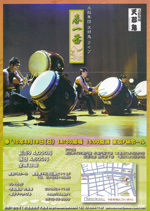
Amanojaku concert


Amanojaku at Tokyo FM Hall
"HARU ICHIBAN (Spring Breeze)"

SUN April 18, 2010
3 p.m. (doors open 2:30 p.m.)

Taiko drumming by
Amanojaku leader/composer Yoichi Watanabe
with drummers
Hiromi Ogawa, Isaku Kageyama, Daisuke Watanabe, Hiromi Sekine, Chris Holland,
and guests
Kyosuke Suzuki on fue flutes, Katsunari Sawada on Tsugari shamisen
also
Amanojaku Hozonkai.

1-7 Kojimachi Chiyoda-ku Tokyo
TEL: 03-3221-0080
3 minute walk from exits 1 and 2 Hanzomon station on the Hanzomon Line.
6 minute walk from exits 1 and 2 Kojimachi station on the Yurakucho Line.

Advance tickets 4,000 yen
Same-day admission 4,500 yen

For tickets, please call Amaonojaku TEL: 03-3904-1745
Ticket Pia (from March 30, 2010)
Pコード:103-507 TEL:0570-02-9999
No reserved seating.

Sunday, January 24, 2010

At One With Brazil

Amanojaku's Yoichi Watanabe and Isaku Kageyama are now in Brazil to share the joy of taiko.
"Kizuna" was co-written by Watanabe and the late Daihachi Oguchi of Osuwa Daiko for the 100th anniversary of Japanese immigration to Brazil, celebrated June 21,
2008 by a performance of 1,000 Brazilian taiko drummers.
The first four minutes of the piece is trademark Oguchi, and then the song breaks into Amanojaku-style taiko that is totally and distinctly Watanabe.
Below is video of a group in Brazil performing "Kizuna" in December:

And this is the same song performed by Amanojaku and students in Japan:

Amanojaku traveled to Brazil 6 times during 2004-2008, teaching more than 600 Japanese-Brazilian youngsters.
The performance was attended by 37,000 people, including Crown Prince Naruhito.
"Kizuna" means "bond" in Japanese _ what is in our heritage and our blood that transcends boundaries and the passage of time to connect people in spirit.
Amanojaku has continued to go to Brazil to teach in 2009 _ and now in 2010.

Thursday, December 31, 2009

The Autobiography of Yoichi Watanabe 2


Isao Tokuhashi and I are working together in compiling an oral history of Yoichi Watanabe, the leader and founder of Tokyo taiko group Amanojaku.
Link to an earlier excerpt, and below another excerpt from the work-in-progress, "The Autobiography of Yoichi Watanabe _ as told to Isao Tokuhashi and Yuri Kageyama":

Most teachers set a two hour or three hour lesson and charge for those hours.
I don’t do that. When I teach a group, I teach from morning until night. That’s because we are going toward the same dream.
Maybe this makes me unprofessional. But I want to be moved. If the people I am involved with are passionate about the music, and they are moved, then I am moved. If I am dishonest to what I believe, I think people will see that.
And so I don’t think about the hours. It’s impossible to teach or create what I want in two or three hours.
The people who perform with me often break into tears. That’s when a teacher can feel truly fulfilled. That’s what I live for.
It’s the same if I go abroad. It gets very busy when I go to Brazil. There is no rest. We are going to lessons from morning until night. But some of the kids are waiting at the hotel for us to get back because they so much want to learn.
I believe that being a taiko drummer was the best job for me. But I also believe that it was a mission given to me by the heavens.
I needed to write a page in taiko history. I wanted to pave the way for those who come after me.
I needed to be able to teach with confidence or else my students won’t be able to play with confidence.
A professional performance is not a recital for friends.
A professional must be spiritually strong like an Olympic athlete undergoing Spartan training.
But without a relationship of trust, a teacher cannot make a student go through that kind of training. If you have not endured this kind of training, and become truly professional, you will be ignored in the professional world.
It all depends on the person. Some need to be scolded. Some need to be praised. Some pick it up without your having said a word, while others never get it even if you tell them many times.
I created the original music that is Amanojaku.
I never wavered. I was always going straight after that goal.
If the roots of a tree are rotten, then it will never flower. But if the roots are solid, the stem will grow strong.
While others paint in colorful oils, I am taking a sumi brush and painting to find my own way. Once I decided that, the rest was easy

Sunday, November 29, 2009

AMANOJAKU Taiko at Sogetsu Hall in Tokyo

THE BEAT OF LEGACY - Dentou no Hibiki
AMANOJAKU Taiko Concert in Tokyo
TUE Dec. 8, 2009
Sogestsu Hall
7 p.m. (doors open 6:30 p.m.)

For tickets, please email: isaku.kageyama@amanojaku.info
Featuring composer, Amanojaku leader and founder YOICHI WATANABE
with HIROMI OGAWA, ISAKU KAGEYAMA, DAISUKE WATANABE, CHRIS HOLLAND and HIROMI SEKINE; guest on fue KYOSUKE SUZUKI.

Sunday, November 1, 2009

The Autobiography of Yoichi Watanabe


Yoichi Watanabe, (photo by Naokazu Oinuma) leader of Tokyo taiko group Amanojaku, is relating his life history and his thoughts on taiko to Isao Tokuhashi and me.
It is a project that has just begun. And a lot of work still awaits.
But it fascinates me for what it promises to deliver in understanding of a great artist, an important era of post-war Japanese creativity and the conceptual and spiritual backbone of modern music called taiko.
Yoichi Watanabe founded Amanojaku in 1987.
But his story _ one man's journey in taiko _ began in the late 1960s, when he was about 10 years old.
He lived through the pioneering years of Tokyo-style taiko, playing with Sukeroku Daiko, founded in 1959 as this city's first professional kumi-daiko troupe.
An excerpt from "The Autobiography of Yoichi Watanabe _ as told to Isao Tokuhashi and Yuri Kageyama":

To be honest, I am not sure anyone would want to read a book about my life.
Besides, 10 years from now, my thoughts are bound to have changed, and I would need to write another book.
But I’ve always wanted to write down a certain philosophy on life that I have arrived at over the years in my own small way.
There is such a thing in life as the correct path _ a “seido.”
I am no different in having pursued what I thought was this correct path for me.
I have been doing it all my life.
I was in fourth grade when I decided I wanted to be a taiko drummer.
And I have never swerved from that path.
And it was just one path.
It was not an easy path, one filled with thorny bushes along the way.
But I have developed a way of looking at life through taiko.
And so this book is not a manual about how to play taiko.
Please look at a DVD or a read a manual textbook for that.
Everyone starts out with a dream, and then many people arrive at another way of life to make a living.
You may want to be a doctor or a pilot. But if you can’t realize that dream, you may have to settle on a more realistic job.
We are supposedly in the worst crisis in a century.
People are all working hard.
Perhaps they would be encouraged to find I have never gone far astray from my path over all these years.
I don’t have anything all that special to say.
It’s very ordinary. It’s no different from everyone else’s dreams.
If you keep yourself open, then you will realize your goal in all its depth and breadth.
That kind of spirit has been lost, this spirit I have strived to pursue all my life.
It’s human to seek the easy way, but I have stuck to the way even if it meant hardships.
If people tell me to go one way, then sometimes I question that and go counter-clockwise.
I have always been a rebel, an Amanojaku.
Thursday, September 3, 2009

Taiko gigs


Photo by Ryan Bruss.
OCT. 4, 2009
AMANOJAKU concert at Kuroiso Bunka Kaikan,
490 Kami Atsu-zaki Nasu Shiobara-shi Tochigi 325-0026.
For tickets, please call 0287-63-3219.
Doors open 1 p.m. Music starts 2 p.m.
2,000 yen (1,000 yen for students).

OCT. 12, 2009
MINYO "LIVE" at Shinjuku Takanoya. 03-5919-0228.
Isaku Kageyama (taiko) with Rie Sakamoto (song), Seiemon Sawada (shamisen), Yoshinori Kikuchi (shakuhachi).
5-2-3-B1 Shinjuku Shinjuku-ku Tokyo 160-0022.
Doors open 6:30 p.m. Music starts 7 p.m.
Advance tickets 2,000 yen; at the door 2,500 yen.
For reservations, email: isaku.kageyama@amanojaku.info

OCT. 17, 2009
AMANOJAKU at DECHIKONKA, annual festival in Ehime Prefecture.
Call Kihoku city hall at 0895-45-1111.
Starts 6 p.m.

OCT. 22, 2009
THE BEAT AHEAD _ Wadaiko "live" at Harajuku Crocodile.
Featuring Isaku Kageyama and Yuu Ishizuka on taikos with Winchester Nii Tete, Chris Holland and other guests.
Call The Crocodile at 03-3499-5205.
6-18-8-B1 Jingumae Shibuya-ku Tokyo 150-0001.
Doors open 6 p.m. Music starts 7:30 p.m.
Advance tickets 3,000 yen. At door 3,500 yen.
For reservations, email: isaku.kageyama@amanojaku.info

DEC. 8, 2009
AMANOJAKU at SOGETSU HALL.
Call Sogetsu Hall at 03-3408-1154.
7-2-21 Akasaka Minato-ku Tokyo 107-8505.
Doors open 6.30 p.m. Music starts 7 p.m.
For reservations, email: isaku.kageyama@amanojaku.info

JAN 10, 2010.
AMANOJAKU Student recital TENSHONOKAI.
Kameari Lirio Hall 03-5680-2222.
Doors open 2 p.m. Music starts 2:30 p.m.
1,000 yen donation.

JAN. 15-FEB. 8
AMANOJAKU workshops in Brazil.

APRIL 18, 2010.
AMANOJAKU concert at TOKYO FM Hall.
Doors open 5:30 p.m. Music starts 6 p.m.
Tokyo FM Hall 03-3221-0080.
1-7 Kojimachi Chiyoda-ku Tokyo 102-0080.
For reservations, email: isaku.kageyama@amanojaku.info

Saturday, August 22, 2009

Talking Taiko _ the Movie


Yoichi Watanabe, master taiko drummer, shows his stuff at Bon Odori _ as he does each and every year (with Daisuke Watanabe and Isaku Kageyama of Watanabe-led Amanojaku).
Bon Odori
Conneting with the past
And all that went before us
Connecting with the future
And all that awaits
A poetic moment
Being a poet is seeing so much more in the everyday.
Bon Odori is the closing scene of "Talking Taiko," a movie I'm working on with Japanese director and film-maker Yoshiaki Tago.
He's doing his stuff on a Shibuya pedestrian walkway _ another place where we are finding a poetic moment.

trailer on YouTube

Do we write to live or live to write?
Do we write to remember or do we write to forget?
Do we write to remember or do we write to be remembered?
Do we write so we don't kill or do we write so we don't kill ourselves?
Do we make movies to live or live to make movies?
Do we make music to live or live to make music?
Do we write to live or live to write?
Do we live?
Do we live?
Do we live?

Thursday, August 20, 2009

Amanojaku at Astro Hall

Amanojaku led by master drummer and composer Yoichi Watanabe did their "live" concert at Astro Hall in Harajuku THU Aug 20.
The stage was so small their pieces like "Dotou" and "Bujin" got a different, bit cramped, look.
But the music was as forceful and fascinating as always.
And it's great Amanojaku is taking stage in a place like Harajuku.
You certainly got a close up look.
Chris Holland, from Denver Taiko, made his professional debut with Amanojaku and got a great strong sound on his odaiko solo.
Go Chris!
Amanojaku will be at a Bon Odori _ Japan's native dance festival for the homecoming of ancestral spirits.
So if you want to get down and dance and have fun, hop on the Seibu Ikebukuro Line to Minami Tanaka Danchi (housing projects) in Nerima Ward.
Get off at Nerima Takanodai station and follow the drumbeat.
Thank the Japanese gods for another summer that's over.

FRI Aug. 21 and SAT Aug. 22
長光寺橋公園盆踊り
練馬区南田中3-31
音出し18:00-21:00

Wednesday, July 22, 2009

Amanojaku LIVE at Harajuku Astro Hall

AMANOJAKU Tokyo's Top-Level Taiko
"SOUL BEAT/TAMASHII NO HIBIKI"
Harajuku ASTRO Hall
THU Aug. 20 7:30 p.m. (Admision starts 7 p.m.)
Advance tickets (includes one drink)
4,000 yen; at door 4,500 yen.
For more information, please call Amanojaku: 03-3904-1745.
Ticket Pia P-code: 330-019
Lawson Ticket L-code: 79754.

Amanojaku, led by master drummer Yoichi Watanabe, concocts an emotional and explosive experience of sound, pitting the best of taiko tradition with global ethnic rhythms and modern composition for a distinct World Music narrative that explores Japanese soul.
Amanojaku teaches taiko in the U.S., Brazil, Asia and Europe, and leads workshops and performs in festivals throughout Japan.
Last year, it led the celebration of the 100th anniversary of Japanese immigration to Brazil in a performance of 1,000 drummers at the samba venue.
Hiromi Ogawa and Mayumi Kawana are founding members of Amanojaku and the best women's duet taiko drummers in the world. They debunk any old-fashioned stereotypes the West may have about Japanese women, inspiring awe with their sheer brute strength and creative integrity.
Also appearing are Daisuke Watanabe, Hiromi Sekine, Chris Holland (from Denver Taiko) and Isaku Kageyama.

Sunday, April 26, 2009

The Giant Drum


"Tamashii no Hibiki" ("Soul Beat") by taiko master Yoichi Watanabe (right in above photo), leader of Amanojaku, is a truly beautiful "odaiko" (big taiko) piece.
It is storytelling in percussion _ the talking drum _ at its height Japanese-style.
The video (in the link below) shows how my son Isaku Kageyama played it as a guest at the Tokyo International Taiko Contest.
He won a couple of contests himself with this piece, starting with the 2000 Mount Fuji contest when he became the youngest player at 18 to ever win the honors.
Please go to the site below, scroll down and download "Soul Beat."
It takes a while but I think it's worth the wait.
Video, though, never quite does taiko justice because of the physical sensation of taiko that goes beyond just hearing it _ imagine the walls, your blood veins, the insides of your brain and all the spaces of air around you shaking.

http://www.isakukageyama.com/english/profile/

Thursday, August 14, 2008

Amanojaku Taiko Concert

Fresh back from a trip to Brazil to celebrate the centenary of Japanese immigration to Brazil, Amanojaku gave two Tokyo concerts this week.
What's striking about their performance is the vision of leader Yoichi Watanabe that is underlined by his fantastic compositions.
Inspired by stark imagery and story-telling, from sword-flicking samurai to the eternal power of dashing waves, Watanabe's tunes never fail to deliver an exciting and articulate musical experience.
His taiko concerts aren't the clap-along feel-good affairs of showmanship that many associate these days with modern taiko.
They make deeper, sometimes painful statements about Watanabe's perceptions on life and art as defined through his compositions/choreography woven together like fabric.
He told the concert crowd about how he composed "Dotou."
He said he started out with a piece for the big drum, and then that evolved into a tune about the snarling waves.
While he was at a studio in a prefecture outside Tokyo to work out the composition, there was a thunderstorm.
There was so much rain the sewage gutter outside the studio began overflowing in torrents.
Thus was "Doutou" born.
Watanabe wrote "Kaiun" after his parents died, and the piece has elements of prayer and wishes for everyone's happiness.
The song has allusions to universal symbols of hard work and preserverance such as worksong chants, swaying of the body and rigorous repetitive beating that is almost excruciating.
But in a mysterious way, the song is also about deliverance from the madness of everyday survival.
It is a moving song about how a man is dealing with the sorrow of losing people he loves, the gratitude he feels toward his forebearers, and the total fear yet total courage artists feel in perpetually facing up to our inevitable deaths.

Wednesday, July 30, 2008

Amanojaku Taiko Concert


AMANOJAKU CONCERTS:

IN TOKYO
Amanojaku Taiko Concert – Celebrating the 100th Anniversary of Japanese Immigration to Brazil
Amanojaku with Kyosuke Suzuki (yokobue flute), Katsunari Sawada (shamisen)
August 13, 2008 Wednesday at 19:00 (Doors open at 18:30)
August 14, 2008 Thursday at 14:00 (Doors open at 13:30)
Nerima Bunka Center TEL: 03-3993-3311
Ticket Prices: Advance Tickets: JPY 4000 
Door Tickets: JPY 4500
All seats are non-reserved
Ticket Pia - http://pia.jp/t  P-Code: 293-971
TEL: 0570-02-9999
Contact: Amanojaku - http://amanojaku.info
TEL: 03-3904-1745 FAX: 03-3904-9434

Amanojaku led by Yoichi Watanabe has just returned from Brazil where they led 1,000 Japanese Brazilian drummers in a performance at a samba venue in Sao Paulo, the Brazilian city with the biggest population of people of Japanese ancestry.
Watanabe has gone to Brazil six times in the last several years to lead workshops in taiko drumming in Japanese communities throughout that nation. This year marks the centenary of Japanese immigration to Brazil, where pioneers went with big dreams after they were blocked entry by segration in the U.S. Taiko has long been a major part of the Japanese American community. Taiko is growing into a major part of the Japanese Brazilian community. Taiko is that pulse that unites people everywhere and helps make that vital connection to our cultural roots.

Sunday, July 20, 2008

More Amanojaku in Brazil

Video footage of a recent Amanojaku concert in Brazil.
"Kaiun" by Yoichi Watanabe.
Players from left to right:
Mayumi Kawana, Isaku Kageyama, Hiromi Ogawa, Yoichi Watanabe.
Yoichi Watanabe, master taiko drummer and the leader of Tokyo taiko group Amanojaku, wrote "Kaiun" after he lost both his father and mother within a scope of about a year.
Like many Japanese, Watanabe has a tight family (both his sons are fantastic taiko drummers), and he was very close to his parents.
The sorrow was a crushing burden that was visible to anyone who saw him those days.
His own health suffered, and he was hospitalized.
But like all great artists, he found in his ordeal a vital force for this composition that is not only about the kind of person his parents always taught him to be _ humbly enduring but always with integrity and vision _ but also about the message of hope and prayer for everyone.
"Kaiun" means "good fortune" in Japanese.
People use the phrase when they wish good luck to others in the same way people in the West say, "God bless you."
"Kaiun" is a powerful spiritual statement of art's transcendence over death and a man's sense of mission to pass on a musical legacy to future generations.
It is a universal statement about how we can never defeat death but how art can give us eternity.

If you want to see "Kaiun" with a better camera angle, please order the Amanojaku DVD from the online store:

http://www.isakukageyama.com/english/onlinestore/

It has all the greatest Amanojaku tunes, including "Bujin" (seen in the YouTube upload below), "Dotoh," "Kagura" and others.
A must buy for all taiko fans and students.

Friday, April 27, 2007

My son and taiko


Photo by Naokazu Oinuma: Isaku Kageyama of Amanojaku.
Every parent should have a stage to boast about their child/ren.
I got to do it recently with an AP article for our online service for young readers asap.
It was a special writing/reporting experience, and I learned a lot about my son.
Music is a way of expressing/exploring identity.
For Isaku, taiko is an important way he can feel comfortable about being marginal _ never being quite all Japanese or all American.
It's all the same in the end.
Art helps us cope with pain.
But it also links with Something larger than life.
Isaku's bilingual blog
Amanojaku's DVD of a recent concert went on sale earlier this year. To get yours, contact Isaku at: isaku.kageyama@amanojaku.info

The power of Amanojaku lies in the composing by the group's founder, leader and creative force Yoichi Watanabe.
Every Watanabe tune is a narrative _ a trickling stream turning into dashing ocean waves, a dirgelike tune that's a testament of parental love, a samurai flashing his/her sword in determined battle.
Watanabe's storytelling is effective because taiko is not only dramatic but also based on nuance _ a feeling in reverberations _ and evocative of sounds from nature and other universal associations.
Watanabe also has that genius sensibility in matching rhythm patterns with truly "kakkoii" moves that are so Japanese.
He also juxtaposes Japanese rhythms with standard Latin beats in intelligent ways so it never becomes gimmicky.
I love that moment when the drummers, one by one, tap out a Latin rhythm in a transition section of "Dotou."
At the end of that segment, when the drummers flick their drumstick against the circular side of their taiko, and then OOOMPH! dive right into a groove, it just feels soooo good, like something jerking your insides probably where your intestines attach to the bottom of your stomach.
You just have to be there.
I've been to their concert so many times, but I still wait for that moment.
Amanojaku on YouTube

Taiko is for the Japanese what conga is for Latin culture, djembe is for African music and traps drumming is for American jazz.

What one Brazilian youngster has to say about what taiko means to him:
Bruno Takao Murakami, a 23-year-old third-generation Japanese-Brazilian, who has been studying with Amanojaku for nearly two years, says taiko has helped him feel proud of his Japanese ancestry.
"Isaku sensei is one of the best teachers I've ever had," he says. "I like his spirit and the way he looks at taiko."